Category Archives: indie films

Marty Supreme: Misadventures of a Table Tennis Hustler


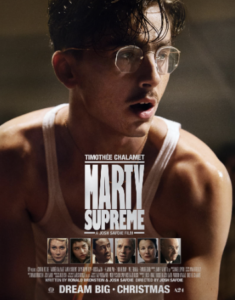
Marty Supreme movie poster.
Movie poster for Marty Supreme showing actor Timothée Chalamet.

Marty Supreme is a fictionalized account of the table tennis player (and hustler), Marty Reisman. I had a greater than average interest in seeing this movie as I played competitive table tennis back in the day (albeit at a very modest level) and actually played at Reisman’s club in New York City now an then. However, the movie is only very loosely based on the actual Reisman.

In fact, it’s less of a sports film than a fast-paced, chaotic journey following the antics of an unhinged and amoral character. Apparently, director Josh Safdie has an interest in table tennis, which drew him to Reisman’s character.

Marty Mauser (brilliantly portrayed by Timothée Chalamet, who also had a notable role as Bob Dylan in A Complete Unknown a few years ago) is a table tennis and all-around hustler in 1950s New York. He works in his uncle’s shoe store but is anxious to leave that job so he can travel and play in tournaments. He takes money at gunpoint from a fellow employee (which he may or may not have been legitimately owed; Mauser walks a moral gray area throughout the film) so he can fly to England to compete.

Marty reaches the finals of the tournament only to be defeated by a Japanese opponent who is using a new type of paddle. This part of the film is based on reality; Reisman did lose to an unheralded Japanese player who was using a revolutionary type of rubber that would change the game forever (though in the movie, he uses plain wood, which is also very tricky to play against).

In between games, Marty manages to hustle (separately) the unlikely couple played by Gwyneth Paltrow and Kevin O’Leary. Paltrow plays an aging movie star who is charmed by the slick Marty. O’Leary, best known as a Shark Tank judge  essentially plays himself, a ruthless CEO who only cares about profits.

The title Marty Supreme comes from a line of table tennis balls Marty invents, which are yellow-gold in color rather than white for better visibility. Other than these fairly short explorations into the niche sport of table tennis (Marty makes a decidedly non-prophetic prediction in the movie that table tennis will one day be a massively popular spectator sport in the U.S.), the film mainly follows Marty’s absurdist  misadventures as he gets a married girlfriend pregnant, unwisely attempts to out-maneuver the O’Leary character, gets chased down by a gang of angry locals after he and a friend hustle them at a club, and gets shot at by
a property owner who finds a dog Marty was watching for someone. In another random sequence,  he manages to get into a bathtub that crashes through the floor.

Marty Fabulous has been compared to Uncut Gems, where Adam Sandler plays a similarly out-of-control character who gets into scarcely believable scenarios. The constant chaos also reminded me a bit of Pineapple Express. In all these films, the specifics of the plot are secondary to the frenetic energy of the characters and the bizarre situations they fall into.

Marty Fabulous is a darkly funny rollercoaster of a movie with a great cast that manages to make the most absurd scenarios almost believable. Chalamet manage to make Marty, if not quite sympathetic, at least someone it’s hard to root against. He moves so frantically from one disaster to the next, we scarcely have time to process how manipulative and self-destructive he often is. And he finally displays some genuine emotion at the very end.

I was a little disappointed that the history of table tennis and the life of the real Marty Reisman were not more prominent, but that won’t matter to 99.9% of viewers.

The Real Marty

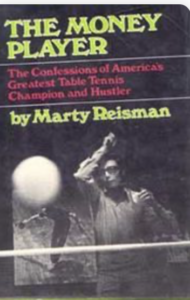
The Money Player book cover
The Money Player book cover with Marty Reisman hitting a ping pong ball.
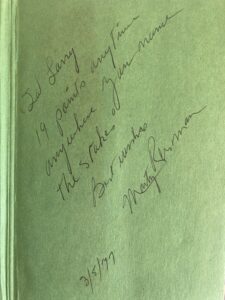
Page autographed by Marty Reisman
Table tennis player Marty Reisman autograph in book The Money Player.


For anyone curio

If you are curious about Marty Reisman (1930-2012), he wrote an autobiography called The Money Player. I still have an autographed copy, but it may be out of print. Maybe this movie will inspire a re-printing.


In Search of a Midnight Kiss: A Chaotic Craigslist Date in LA

In Search of a Midnight Kiss poster


In Search of a Midnight Kiss (2007) is one of those under-appreciated indie films from the 2000s that’s now getting a revival via streaming. It’s appealing for several reasons, at least if you appreciate low-key films that emphasize characters and dialogue over action.

Alex Holdridge directed this micro- to low-budget film set in Los Angeles. It’s all about an extended date between 20-somethings Wilson (Scoot McNairy) and Vivian (Sara Simmonds), who meet on Craigslist to avoid spending New Year’s Eve alone.

There’s not too much plot to discuss, as most of the movie shows Wilson and Vivian wandering around LA. It turns out both are in an emotionally fragile space, and they alternately bond and quarrel. The meandering conversations as the pair aimlessly wander are reminiscent of Richard Linkater‘s Before Sunrise, but Holdridge inserts more volatility between the two (Linklater saved that for Before Midnight, the third in his trilogy).

Aside from the attraction-repulsion energy between the two, Vivian is contending with a possibly psychotic ex named Jack (Robert Murphy) who threatens (on the phone) to kill Wilson with a shotgun. At this point, I thought the film would take a turn similar to Something Wild (1986), where Jeff Daniels and Melanie Griffith have a wild, spontaneous date until they are pursued by the latter’s violent ex (Ray Liotta, in one of his best pre-Goodfellas roles), and the whole tone of the film turns darker. But In Search of a Midnight Kiss maintains its focus on Wilson and Vivian and Jack fades into the background.

We also get to spend some time with Wilson’s roommate Jacob (Brian McGuire) and Jacob’s girlfriend Min (Kathleen Luong), who may or may not get engaged.

If you’re an action addict or even someone looking for a feel-good rom-com, you should probably skip In Search of a Midnight Kiss. It’s an understated dramedy that underlines the fragility of modern relationships in a big city. There’s also nice footage of the city, including parts of downtown LA and East Hollywood that aren’t as commonly filmed as more touristy areas.

Apart from its other charms, the movie serves as a time capsule of a distinct moment in culture and technology right before the smartphone era. Video stores were still around, people used both flip phones and landlines, MySpace and Facebook co-existed, and websites were still novel and quirky. Vivian boasts about her own site dedicated to lost shoes. As a random piece of trivia, this website, The Lost Shoe Project, actually existed at one point.

In Search of a Midnight Kiss is currently streaming on Amazon Prime and other platforms.

Sidewalls: Romance Amidst Urban Alienation


Medianeras movie poster

Sidewalls had its start as a short film in 2006. The full-length version was released in 2011 and has only recently come to streaming services. The original title of this Argentinian movie is Medianeras. Directed by Gustavo Taretto, it’s a semi-comic exploration of urban alienation in the modern world.

Although Sidewalls got some attention at film festivals in Latin America, it’s one of those under the radar independent films that’s easy to overlook but that’s hopefully enjoying a new streaming audience.

The movie starts like a documentary, with a voiceover by Martin (Javier Droias) describing the architecture of Buenos Aires. He notes that the haphazard way dissimilar buildings are placed right next to each other reflects poor planning, which in turn reflects the poor planning of our lives. Much of this could apply to any modern city.

Martin is a web designer who is borderline agoraphobic, staying mostly in his small apartment. We then meet Mariana (Pilar López de Ayala), a young woman who lives in the same neighborhood. She is an architect who currently works designing storefronts. She keeps mannequins at home, which she sometimes interacts with.

The movie alternates between these two lonely characters as they wander around the city, have bad dates, and wonder why modern life seems so empty. Of course, the big question is whether these two will ever meet. There have been a few rom-coms using a similar device, Sleepless in Seattle probably the most famous. But Sidewalls is more than just a rom-com; it’s a look at urban anomie and how it makes meaningful relationships so hard to find.

The technology in Sidewalls is a bit dated, which reflects its 2006 origin. The characters all use flip phones, though they’re already addicted to texting.

The message, though,  is as relevant as ever if not more so.  People are obviously more dependent on their devices than ever. Martin is a bit ahead of his time, working at home and having all his meals delivered, practices not as common in the 2010 era.

The architecture theme is interesting as well,  as building and streets certainly have an impact on how we feel and interact.

Sidewalls is the kind of quirky, unpredictable indie film I tend to enjoy. The characters don’t always behave rationally, but the whole point here is that modern life alienates people and breeds loneliness and neurosis. If there’s any message here, it’s simply that being immersed in electronic devices isn’t likely the path to human connection or happiness.

Sidewalls is currently streaming on AMC+ and other sites. As of this writing, it’s not on any free streaming platforms.


Kwik Stop: Low Key, Overlooked Indie Film Now on Amazon Prime


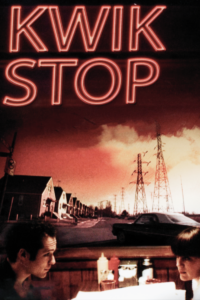
Kwik Stop movie poster

Kwik Stop was released in 2001 but, despite winning several film festival awards, didn’t get much attention or distribution. It’s recently been added to Amazon Prime, so hopefully it will get a wider audience, which it truly deserves. A Slate article  by Charles Taylor argues that the lack of fanfare around Kwik Stop reveals everything that’s wrong with the movie industry. This article is from almost 10 years ago; if anything, things are worse today.

Michael Gilio wrote, directed, and is one of the stars of Kwik Stop, a hard to label micro-budget film that doesn’t often do what we expect. Set in a dismal, generic American landscape that appears to be somewhere in the Midwest.

It starts as a young guy who calls himself Lucky (Gilio) drives up to a convenience store in a classic car. Between his car and haircut, he looks like a James Dean character. After doing some petty shoplifting, he’s confronted by Didik (Lara Phillips), a teen who’s anxious to leave town. She threatens to tell a nearby cop about Lucky’s crimes if he doesn’t give her a ride. He plans to drive to Hollywood to become an actor. Didi wants to tag along.

With this start, Kwik Stop looks at first to be a road movie, possibly the violent kind along the lines of Bonnie and Clyde or Badlands. However, neither of these characters is quite capable of acting out such extreme actions. They are limited by a kind of circumstantial and existentialist quicksand that prevents them from getting too far.

What follows are some mild spoilers, though Kwik Stop is not a plot-driven movie, so there’s not really much to spoil.

Lucky and Didi have a series of fairly absurd misadventures involving burglaries that result in Didi getting sent to a juvenile detention center. Lucky then concocts an absurd scheme to break her out, recruiting his ex-girlfriend to assist. This sequence of events is part of what’s refreshing about the movie. Your first instinct may to think, “this is too ridiculous; no one would do anything like that.  But when you think about it, it’s so ridiculous that it seems like it could be true. It’s actually too ridiculous to fit into a formula novel or screenplay.

Along with Lucky and Didi, a depressed alcoholic named Emil (Rich Komenich) gets sucked into Didi’s chaotic life. He’s a sad sack character who proves to be more complicated than he first appears.

To appreciate Kwik Stop, you need to take a step back from the characters and understand that no one really knows what they’re doing. They are oddly believable as people who are making everything up from one moment to the next.

As the aforementioned Slate article  points out, some of Kwik Stop‘s absurdity is reminiscent of early Jim Jarmusch films such as Stranger than Paradise and Down By Law. Later mumblecore movies of the early 2000s also have some similarities. However, Gilio has a distinct style of his own. Jarmusch’s characters, often seem like they are in a perpetual existentialist fog. By contrast, Lucky and Didi actually seem to believe they are headed somewhere; it’s just that their plans and actions are so confused and self-defeating that they have no chance of achieving their goals.

Kwik Stop is the kind of low key, unpredictable indie movie that’s all too rare these days. It’s currently streaming on Amazon Prime, FreeVee, Apple TV, and other services.


My Dinner With Andre 40 Years Later


My Dinner With Andre, directed by Louis Malle, is a cult classic from 1981 that is still widely discussed today. It’s been called a prophetic look at a society that is increasingly alienated and dominated by technology. I hadn’t seen it for many years, so I thought it would be a good time to rewatch it and share my thoughts.

Just a Conversation

If you’ve never seen it, My Dinner With Andre is simply about two men, actor and playwright Wallace Shawn and theater director Andre Gregory, playing themselves, having dinner at a restaurant. Yes, it’s all talk. The only thing that prevents it from seeming like a stage play are the scenes before and after the dinner, where we are treated to some vintage scenes of New York City in the early 80s.

There aren’t very many movies, especially popular ones, that are 99% dialogue. Some of Richard Linklater’s films, such as the Sunrise-Sunset trilogy are dialogue-heavy, but in that case there’s a romantic mood as well as a variety of scenes (e.g. European cities). Waking Life is a closer comparison, as it’s full of philosophical inquiries, but that film diverts us with animated special effects. My Dinner With Andre is just two guys sitting in a restaurant for almost 2 hours. Yet, the movie continues to captivate viewers more than 40 years after its premier.

Does My Dinner With Andre Have a Theme?

Fortunately, Wally and Andre aren’t just uttering random, meandering thoughts. Although their conversation veers in many directions, there are some central themes. Andre introduces a fairly radical criticism of modern society, describing how people are almost entirely inauthentic and sleepwalking through life. His point is reminiscent of the mystic George Gurdjieff, who spoke of people being unconscious. I don’t believe Andre mentions Gurdjieff, but he does refer to Zen, which emphasizes living in the moment. Wally, meanwhile, argues for a more conventional and less confrontational attitude.

I suspect the disagreements between Wally and Andre are a bit exaggerated for dramatic effect. Most of the discussions revolve around Andre’s outlook while Wally takes on more of a Devil’s Advocate role as he upholds the virtues of bourgeois comforts over adventure and radical discontent.

One could say Andre’s point of view reveals a certain bourgeois privilege, as he has the freedom to travel the world in his quest for self-actualization. Of course, he understands this fully and expresses the requisite self-loathing that is, ironically, also characteristic of bourgeois intellectuals.

A Prophetic Movie?

It’s popular in some circles to look back at all the dystopian prophets, such as Orwell and Huxley, and discuss who came closer to the truth. My Dinner With Andre is sometimes mentioned as a prophetic work.

Many of the topics do take a grim view of modern civilization and the direction it’s headed. It’s especially disturbing to hear about alienation and self-preoccupation in 1981, about 15 years before internet culture, much less smartphones and social media.

I don’t think Andre is a prophet as much as an astute observer of what was already happening. He says at one point that the 1960s were the  “the last burst of the human being before he was extinguished.” To understand this point of view, it’s helpful to consider the era when these comments were made.

While it’s easy to be nostalgic about the 80s now, it was actually a rather pessimistic time, especially in big cities. The economy was in a recession, it was the middle of the Cold War, and the AIDS epidemic was peaking. This was also the beginning of the decline of New York’s (and America’s) middle class due to soaring housing costs. We get a glimpse of this mood early at the beginning of My Dinner With Andre, as Wally mentions his struggle paying bills and boards a graffiti-ridden subway.

It’s not entirely coincidental that Escape From New York, the post-apocalyptic thriller starring Kurt Russell as the vigilante anti-hero who rescues a US president who is trapped in a New York that has been turned into a prison, also came out in 1981. As different as these two films are, they share some of the dystopian angst that was in the air during that time.

Andre’s Vision of a New Underground

Andre’s vision is not wholly pessimistic. He advocates for a type of underground to keep civilization going during these new dark ages, using the model of communities such as Findhorn in Scotland, which is famous for its innovative agricultural methods and neo-pagan outlook.

This notion is similar to the  concept of temporary autonomous zones, an anarchist ideal that advocates the formation of spontaneous pockets of resistance and culture. Sadly, such idealistic visions have not fared well when people make a serious attempt to implement them.  This was brought to light in 2020, when an actual “autonomous zone”  called CHAZ (Capitol Hill Autonomous Zone) sprung up in Seattle, where the initial euphoria soon degenerated into violence.

Similar problems have  plagued other utopian communities, including many that sprung up in the 1960s. I am digressing, but the point is that the kind of idealism Andre expresses is more easily experienced by financially independent individuals than by groups of people from disparate backgrounds who must contend with everyday survival and  conflicting social forces around them.

Was the Movie Scripted or an Improvised Conversation?

As Wally and Andre talk, it would be easy to believe that the movie is a documentary, capturing a spontaneous conversation. It turns out that this was not the case. As you can read in the review by Roger Ebert, the film was actually carefully scripted and was taped over a period of several months. So the conversation reflects the two men’s actual personalities but we can assume many of the events discussed (especially in Andre’s life) were invented or exaggerated for dramatic effect.

My Dinner With Andre: A Timeless Classic

My Dinner With Andre is a movie worth watching every so often. Surprisingly, it doesn’t seem dated today (aside from the shots of 1981 New York of course). Most of the topics they discuss are timeless. On the one hand, intellectuals have long bemoaned the decline of civilization. On the other hand, the modern world does seem to be getting ever more chaotic, alienated, and fragmented. My Dinner With Andre may not provide any solutions, but it can help to clarify some of the questions.

Watch My Dinner With Andre on Amazon Prime

May December -Complex Handling of a Tabloid Topic

May December deals with the kind of tabloid-type topic you’d expect to see in a Lifetime movie or, going further back,  a TV movie of the week. The kind of movie that superficially condemns the scandalous behavior of its characters while titillating the audience.

Now imagine such a topic as handled by a director known for his insightful and complex approach such as Todd Haynes, and you have May December, a made for Netflix production. To be clear, May December does titillate the audience, but in a way that’s intended to make you feel guilty or at least uncomfortable for this.

May December is loosely based on a real incident of a teacher’s affair with a student.

Gracie (Julianne Moore) is a woman whose life has been defined by a scandal. When she was in her thirties, she seduced a 7th grade kid named Joe (Charles Melton), for which she went to prison. However, after she was released, Grace and Joe married and had kids. As the setting is a respectable suburb in Savannah, Grace’s standing in the community is ambiguous at best.

A strange detail to note is that the family, apparently supported by modest local jobs, somehow live in a grand home that could be called a mansion on a scenic lake. Perhaps Grace inherited it or had family money? Characters living above their realistic means is a common trope of movies and television but doesn’t really fit into  this otherwise more sophisticated film.

Elizabeth (Natalie Portman) is an actress who is playing Grace in a movie. She arranges a visit, staying in town, so she can get to know the family and learn more about the character.

May December is all about the troubled and ambivalent interactions between characters, especially between Grace and Elizabeth but also between Grace and Joe and between Joe and Elizabeth. There are also the nuanced interactions between Grace and Joe and their just-grown children.

In some ways, Grace still treats Joe like a child, even while insisting he was “in charge” in their earlier relationship. Considering his reticent and basically passive nature, this interpretation seems unlikely. Joe retreats to his hobby of raising monarch butterflies, which no doubt has symbolism as he seems trapped in a situation he fell into while still a child.

Elizabeth (Natalie Portman) is a strange case herself. She seems more fascinated and turned on than shocked by Grace and Joe’s history. In one scene, she visits the back room of the pet shop where the couple used to meet and re-enacts a seduction scene.

As with most Todd Haynes films, May December doesn’t answer many questions definitively. All of the characters are troubled and we can’t necessarily trust any of their motives. Elizabeth may have designs on Joe, but to what end remains unclear. Is she an actor who is obsessively dedicated to her craft or more of a voyeur reveling in other people’s scandals? Or perhaps the film is suggesting that these two are not mutually exclusive.

Grace may have been sexually assaulted by a brother growing up, which may partly explain her own behavior. She denies this ever happened and we are left wondering.

The film is alternately dramatic, tragic, and comedic, not giving us a chance to fall into a predictable mood. Haynes directed one of my favorite films, Safe, which came out in 1995 and also starred Julianne Moore.  Like May December, it deals with some heavy issues -in this case, health and how the world can make some people ill- in a disturbing and ambiguous manner. May December is a similarly complex exploration of issues that tend to get oversimplified.

See my review of Safe

Another Version of You: Romcom Explores Parallel Realities

Movies about parallel realities have been popular for a while, at least as far back as Sliding Doors (1998). Another Version of You (2018) is a low key entry into this genre. If you’re fascinated by the possibility that you can shift into alternate versions of yourself, this movie, written and directed by Motke Dapp, is worth checking out despite its shortcomings.

Diggsy (Kristopher Wente)is heartbroken that the woman of his dreams, Suzette (Sara Antonio) has married another man. A mysterious stranger in a bar hands him a key that allows him to shift realities, and off he goes.

Diggsy plunges into dozens of realities and meets different versions of Suzette, including a crazy one and one who is very ill. He also has a fling with another woman named Gwyneth (C.J. Perry) and meets different versions of his sister Daphne (Brittany Belland).

Diggsy visits all kinds of locations, which are never specified. There are scenes in various cities in North America and Europe. Apparently some of the film was shot in Iceland. Not sure why a movie with international locations wouldn’t boast about it.

Many of the scenes are basically montages of Diggsy jumping into other realitie. Some of these seemed like skits on a show such as Saturday Night Live. The ending was open-ended, which I suppose isn’t a bad thing with a movie whose point is that life can be almost anything.

I probably approach this kind of movie too literally, but I tend to fixate on practical details.  For example, how does Diggsy get by? Do his credit cards and bank account follow him from one reality to another? At one point, he even rents an apartment and buys furniture.

I also found the insularity of the concept a little claustrophobic. If you were visiting parallel realities, wouldn’t you be at least a little curious about the world beyond your romantic interest? There’s one reference to a movie having a different cast (in one reality, The Matrix stars Will Smith instead of Keanu Reeves) but nothing else about how the world might be different.

Another Version of You is an extremely lightweight look at a fascinating concept. It won’t provide you with any deep insights into the nature or reality or even human relationships, but it’s a pleasant enough diversion.

Another Version of You is currently streaming on Amazon Prime and possibly elsewhere.

Film Fest: A Movie About Making Movies

As you can probably tell from the title, Film Fest is one of those meta exercises, an indie film destined for film festivals about an indie film premiering at a film festival. The main difference is that Film Fest actually premiered at the Austin Film Festival in 2020, whereas the fictional film is premiering at an obscure film festival in an unnamed (though scenic) location in the mountains.

Directed by Marshall Cook, Film Fest follows the struggles of indie director Logan Clark (Matt Cook). In the first scene, he is desperately pitching his finished movie, appropriately named Unknown Unknowns at a party where he’s working as a server. He’s not so gently rebuffed by an agent while his boss threatens to fire him.

The film’s producer, Alex Davis (Diona Reasonover) reveals that there’s a film festival that actually wants to premier Unknown Unknowns. The catch (the first of many, as it turns out) is that it’s an obscure festival called Hollywylde that no one has heard of. Though at first ready to refuse and wait for something better, Logan reluctantly goes along for the ride. He, Alex, their cinematographer (Laird Macintosh) who affects a fake Swedish accent, and PA make the journey to try their luck. Logan quickly goes from feeling the whole thing is beneath him to desperately wanting to come away a winner.

Film Fest is a spoof and insider’s look at the pretensions and often petty competitiveness of film festivals, where unknown directors desperately want to break through and outshine their peers. The fictional Hollywylde Festival, of course, is shadier and sketchier than even your average obscure film festival. It turns out that every entrant in the festival has been nominated for all the top awards. The festival’s creator is a bombastic character in a cowboy hat named Montgomery Nash (Will Sasso) who privately tells every participant that their film is his favorite.

Logan is portrayed as just as opportunistic and prone to compromising his values as anyone else. There’s a scene where Logan and Alex pitch their movie to agents and are immediately shot down because they lack a clear pigeonhole or star that will make it a predictable hit. Film Fest is an interesting and funny look at the world of independent filmmaking and how only the most dedicated will persevere in the face of such long odds.

Film Fest is currently streaming on Amazon Prime as well as YouTube.

Puzzle Review: A Woman Discovers Herself By Solving Puzzles

Marc Turtletaub, who produced notable indie features such as Safety Not Guaranteed and Little Miss Sunshine, is the director of Puzzle, an interesting, low-key drama about a woman who discovers that she has an unusual skill -solving jigsaw puzzles incredibly fast. As we’re introduced to Agnes (played by Scottish actress Kelly MacDonald), she is celebrating her birthday with friends and family with the look of someone enduring more than enjoying the occasion. Her life is conventional in a traditional working-class manner —living in the suburbs, cooking for her husband (auto mechanic Louie, played by David Denman) and sons, and active with the church.

One of Agnes’s birthday gifts is a jigsaw puzzle, which she effortlessly completes. After finding that the puzzle was purchased in downtown Manhattan. She takes the Metro North train (I’m not sure if she’s in Westchester, upstate NY, or Connecticut) for the first time and even finds buying a train ticket confusing.
In addition to buying some new puzzles, she finds a flyer someone posted advertising for a “puzzle partner.”

Agnes’s puzzle adventure really starts when she meets her puzzle partner Robert (the late Irrfan Khan, who sadly died not long after Puzzle was released), an eccentric, independently wealthy inventor who uses puzzles as a way to discipline his wandering mind, as he explains it (paraphrasing here). The world-weary intellectual Robert is about as far from Agnes’s home life as could be imagined. Agnes hides her new pastime and friendship from Louie, telling him that she’s caring for a sick relative. Somewhat predictably, as Agnes and Robert practice for a puzzle tournament, they become attracted to each other.

Despite her feelings for Robert and her enthusiasm for the new world he helps her discover, Agnes is not quite ready to leave her old life. She’s very attached to her sons, especially the sensitive and confused, and floundering Ziggy (Bubba Weiler). And, despite rebelling against Louie’s extremely old-fashioned values (when Ziggy talks about becoming a chef, Louie objects that it’s not a very manly profession), Agnes still has feelings for him.

What really matters in Puzzle isn’t so much what people do but how they do it. I wasn’t originally keen to see Puzzle as jigsaw puzzles don’t seem promising as a subject for a movie. Chess is another cerebral activity that has inspired a couple of good films, such as Searching For Bobby Fischer The Queen’s Gambit. But even chess, as a competitive strategy game, has more opportunity for drama than the basically solo activity of puzzle-solving. Fortunately, the movie doesn’t spend too much time actually showing people do puzzles but is much more concerned with why they do them.

Puzzle manages to avoid the expected sports movie formula (that can also apply to other competitive pursuits such as chess, dance competitions, etc) as the prodigy wins one tournament after another until he or she faces down the big rival in the final scene. Puzzle succeeds as an original and compelling drama largely because the actual puzzles remain mostly in the background. While the journey of a woman who discovers there’s more to life than being a wife and mother is familiar, Puzzle, largely due to magnetic performances by MacDonald and Khan, manages to break through and tell a compelling and original story.

Puzzle is currently streaming on Amazon Prime.

The Lost Daughter: Enigmatic Character Study

The Lost Daughter, which premiered on Netflix right before the New Year, shows that Netflix aims at quite a diverse audience. The recent hit Don’t Look Up is a sendup of pop culture (with some heavy-handed messages); Cobra Kai attracts a mixture of older viewers nostalgic for The Karate Kid as well as younger, newer fans of the franchise. Meanwhile, The Lost Daughter is an ultra-indie offering based on an Italian novel. If you’re looking for action, sex or politics you won’t find it here. However, it is an interesting character study that also manages to be disturbing in its low-key way.

The Lost Daughter is the first film directed by Maggie Gyllenhaal, who is also the co-writer along with the novel’s author Elena Ferrante. It stars Olivia Colman as Leda, a native of England who is currently a professor in Boston. Leda is on a solo vacation on a Greek island, where she, at first, seems to mainly want to be left alone.

Leda is a difficult character to understand or sympathize with. She is alternately aloof, hostile, and friendly to the people she meets such as her apartment’s caretaker Lyle (Ed Harris) and Will (Paul Mescal), a young Irish student working at the resort for the summer. Her solitude on the beach is interrupted by a large and loud American family. However, after a brief altercation over seating, she becomes interested in Nina (Dakota Johnson), one of the family who has a young daughter.

When Nina can’t find her daughter, everyone panics and searches the beach. Leda, however, finds the young girl and is at least temporarily embraced by the family. However, complications ensue when the daughter’s beloved doll is missing. Probably the closest thing to a spoiler I can reveal here I a film with no real action is that Leda has taken the doll because it apparently reminds her of a doll she used to have.Leda’s encounter with Nina and the child reminds her of the past and the film then slips in and out of flashbacks of Leda as a younger woman (played by Jessie Buckley) who has two young daughters of her own.

I haven’t read the novel, but a lot seems to hinge on Leda’s introspection. Apart from the flashbacks, however, it’s hard to understand her motivations. She is clearly troubled about the past, which seems to be mainly due to a period when she abandoned her husband and children. Perhaps she sees herself in Nina and her daughter, though she seems almost more obsessed with the doll than with the actual people.

The conclusion is a bit ambiguous and can be interpreted in multiple ways. If you’re a fan of quiet, introspective films that don’t offer simple explanations or resolutions, then The Lost Daughter is something worth checking out.