
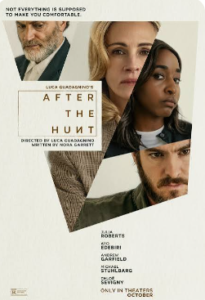
Hollywood and academia can be seen as the two biggest proponents of “wokeism,” so you don’t really expect a scathing indictment of this phenomenon from a relatively mainstream movie. And After the Hunt doesn’t deliver this. While it tentatively pokes a flimsy stick at sexual assault, class, gender, and race, its approach is so confused and ambiguous that it’s sure to antagonize people on all sides of these contentious issues.
After the Hunt boasts a talented director ( Luca Guadagino) and cast, including Julia Roberts, Ayo Edibiri, Andrew Garfield, and Chloe Sevigny. The original screenplay by Nora Garrett may be the weak link here, as the movie has quite a few interesting characters and scenes but doesn’t quite come together in a coherent manner.
Unlike some movies where academia is the setting, After the Hunt really immerses itself in actual academics, in this case philosophy. While we (thankfully) don’t listen to entire lectures, there are ample quotes and discussions of modern and postmodern philosophers such as Heidegger, Hanna Arrendt, Foccault, and others.
Unfortunately, the film’s academic credentials collapse in an early scene, when a professor (or perhaps a graduate student; I don’t recall exactly who said it) labels Nietzche a literal Nazi. Hitler, who mined all kinds of sources for his muddled ideology, did praise the 19th century philosopher. But Nietzche died in 1900, more than 30 years before Hitler’s party came into power. This is a common misperception you might expect from an undergraduate, but not from PhDs, graduate students, or screenwriters who did their research.
The film’s crucial incident occurs when graduate student Magggie (Edibiri) accuses a male professor (Garfield) of “crossing a line” (it never gets more specific than this, part of the film’s fealty to vagueness. The complication is that Alma (Roberts) is close to both of them. Maggie is her star student and Hank is a friend and former lover.
Though Hank vehemently denies the charge, he is summarily fired. Whether or not he’s guilty is, oddly enough, not a major theme of After the Hunt. It’s more about Alma’s ethical dilemmas and her declining ability to hold it all together. To make it worse, both she and Hank were on track to get tenure. Hank’s obviously blown his chances but Alma isn’t far behind on the self-destructive track. She has an unnamed (till late in the film) ailment that causes her severe pain and for which she takes painkillers.
The biggest elephant in the lecture hall is the accusation of plagiarism against Maggie. Hank claims that she blatantly plagiarized her thesis. While this would not in any way justify transgressions on his part, it would, in the real world, be enough on its own to get a student kicked out of any college. It’s also fairly easy to prove or disprove plagiarism. So it’s a serious gap for a film set in academia to just skipping over an issue like this.
By the end of the movie, we don’t really know much of who did what and none of the characters comes across as especially sympathetic.
What is the Point?
Despite its shortcomings, After the Hunt has many effective scenes. The trouble is, they don’t really combine to form a coherent whole.
One of the taglines for the film is “Not everything is supposed to make you comfortable,” a line that Alma utters to Maggie. This suggests a critique of an overly sensitive environment found in higher education today, especiallyat Ivy League universities.
Yet Alma is hardly a conservative defender of traditional values. As the British like to say, she constantly waffles: between Maggie and Hank, between feminism and a more conservative (or perhaps classical liberal) outlook. As Alma waffles, so does the film.
There have been some, though not many, Hollywood films that have successfully lampooned both, or multiple, sides of controversial issues. One I can think of offhand is Citizen Ruth. It’s admittedly a precarious tightrope to walk, as the most likely outcome is to alienate people from both sides.
If After the Hunt does have a point, it’s probably an unintended one. If anything, you come away feeling that postmodern philosophy results in a world of radical subjectivism, where clearcut moral standards are hard to pinpoint.